
Choosing natural stone for luxury villas in Saudi Arabia involves more than finding an attractive slab. The material must suit the architecture, location and installation area. A cream travertine that works on a shaded Riyadh facade may need different detailing near the humid coast of Jeddah or Dammam. For architects, developers and contractors, the best decision balances appearance, performance, maintenance and supply continuity.
Start With the Villa Location and Exposure
Stone exposure varies by city and application. Inland projects face intense sun, dust and daily temperature changes. Coastal villas add humidity and airborne salts. Pool decks and entrance steps face water, traffic and slip risks that do not apply to an interior wall.
Before selecting natural stone for luxury villas in Saudi Arabia, divide the project into exposure zones:
- Exposed facades, boundary walls and landscape features
- Shaded terraces, entrances and pool surrounds
- High-traffic interior floors and stairs
- Decorative walls, backlit features, bathrooms and vanities
Compare Stone Types by Application
Natural stone varies by quarry, block and batch. Use this comparison as a starting point, then verify test data and project requirements.
|
Stone |
Character | Suitable villa applications |
Points to confirm |
|
Marble |
Refined veining and a polished or honed luxury appearance | Living areas, stairs, bathrooms, wall features and formal entrances |
Finish, stain exposure, slip resistance and suitability of the selected variety for exterior use |
|
Travertine |
Warm neutral tones with linear or cloud-like movement | Facades, courtyards, wall cladding, terraces and selected interiors |
Filling method, porosity, sealing, vein direction and consistency across batches |
|
Granite |
Dense appearance with strong wear and weather resistance | Exterior paving, steps, service areas, landscape elements and high-traffic floors |
Surface temperature of dark colours, finish, thickness and slip resistance |
|
Onyx |
Translucent colour and dramatic natural movement | Backlit walls, reception areas, bars, powder rooms and decorative features |
Slab reinforcement, lighting mock-up, bookmatching and careful handling |
|
Crystal stone |
Bright crystalline appearance and clean architectural character | Feature walls, floors, stairs and selected cladding applications |
Test results, finish, dimensional accuracy and approval for the intended exposure |
Marble works best where its veining can be composed across a visible surface. Travertine suits warm facades that complement desert colours. Granite is practical for demanding outdoor areas, while onyx is better treated as a controlled decorative material.
Select Colour and Veining at Project Scale
A small sample shows colour and finish but not the full range of a material. Light beige, cream and pale grey stones work well with strong Saudi daylight and generally absorb less solar heat than very dark surfaces. Still, review samples under the intended lighting.
For marble, onyx and vein-cut travertine, specify bookmatching, continuous vein flow, random installation or controlled blending before cutting. For large floors and facades, request batch photographs or a dry-lay review rather than relying on one sample.
Match the Finish to Safety and Maintenance
Finish affects both appearance and safety. Polished stone adds depth and reflection; honed stone feels softer and more contemporary; brushed or sandblasted surfaces can provide better grip outdoors. Use an appropriate textured finish around pools, exterior steps, ramps and wet entrances, subject to the project’s slip requirements.
Plan maintenance at the same time. Marble and travertine can be affected by acidic cleaners. Sealing depends on the stone, finish and exposure, so the supplier, installer and maintenance team should agree on a compatible system.
Put Technical Performance Before Assumptions
Stone names do not prove performance. Depending on the application, the consultant may request data for:
- Water absorption and density
- Compressive and flexural strength
- Abrasion resistance for floors and stairs
- Slip resistance for wet or exterior surfaces
- Anchor strength and panel behaviour for mechanical cladding
- Dimensional tolerances, thickness and surface finish
The consultant should define acceptable values and the applicable ASTM, EN or project-specific methods. Exterior cladding also needs engineered fixings, movement joints, drainage and suitable substrate preparation. A good stone can still fail when installation details are poor.
Approve a Control Sample and Mock Up
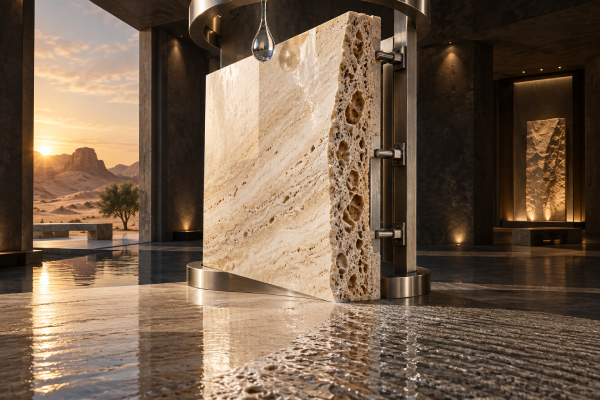
Keep a signed physical control sample recording the accepted colour range, finish, filling and edge treatment. For a major facade, floor or bookmatched wall, build a representative mock-up before full production.
A useful mock-up allows the project team to evaluate:
- Colour variation across several pieces
- Joint width and grout colour
- Vein direction and panel sequence
- Appearance in daylight and artificial light
- Visible fixing details, sealing and final sheen
This approval prevents many disputes after the material reaches the site.
Plan Quantity, Inspection and Shipping Early
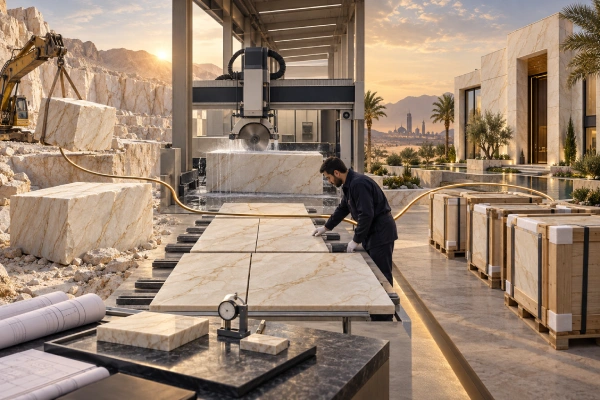
Confirm the cutting schedule, approved sizes, packaging method, destination and delivery window early. Add a project-specific allowance for cutting, breakage, future repairs and shade matching rather than ordering only the net installed quantity.
Before shipment, compare production with the approved sample and specification. Check dimensions, thickness, finish, edges, visible repairs, quantities, crate identification and packing. For sequenced facades or dry-laid floors, labels should match drawings or installation zones.
Packing must protect faces, corners and long pieces. Crate numbers and loading records should let the site team identify materials without opening every package.
Evaluate the Supplier as Part of the Specification
The right natural stone supplier for Saudi Arabia should do more than quote a low price. Confirm that it can control the source, secure compatible blocks, reproduce the finish and coordinate custom fabrication. Before placing the order, confirm:
- Available quantity for the complete project
- Colour and finish control across phased deliveries
- Cut-to-size, edge or CNC capabilities where required
- Inspection records and replacement procedures
- Export documentation, packing and shipment coordination
The lowest unit price becomes expensive when inconsistent batches, site recutting or delayed replacements interrupt installation.
Final Checklist for Natural Stone for Luxury Villas in Saudi Arabia
Before approval, state the stone, application, finish, size, thickness, edge treatment and acceptable variation. Attach the control sample, drawings, quantity schedule, tests, inspection plan, packing instructions and delivery terms.
Stonix connects international buyers with selected producers of marble, travertine, granite, onyx, crystal stone and custom stone products. For villa, hospitality and commercial projects across Saudi Arabia, the wider GCC and CIS markets, our team can support material selection, specification review and export coordination. Contact Stonix to discuss your application, quantity, sizes and required delivery destination.
Frequently Asked Questions For Natural Stone for Luxury Villas
What is the best natural stone for villa facades in Saudi Arabia?
There is no single best choice. Travertine suits warm, elegant cladding, while granite can serve highly exposed areas. Selected marble or crystal stone may also work with appropriate test data, detailing and consultant approval.
Is marble suitable for outdoor use in Saudi Arabia?
Some varieties can be used outdoors, but confirm absorption, strength, weathering behaviour, finish, thickness and fixing details for the specific material and facade system.
Which stone finish is best around a villa pool?
A textured, slip-conscious finish is generally preferable to a high polish. Consider barefoot comfort, drainage, cleaning and the consultant’s slip-resistance requirement.
How can buyers control colour variation in a large order?
Approve a physical range sample, reserve sufficient material from compatible blocks, review batch photographs or dry-laid pieces and define how the stone should be blended. Sequenced crate labels also help installers maintain the approved layout.
What information should I send when requesting a stone quotation?
Provide the stone type or reference image, application, finish, dimensions, thickness, quantity, edge details, drawings, delivery destination, schedule and any testing or inspection requirements. The clearer the request, the more accurately a supplier can assess production and logistics.